


My projects
Home Automation of Residences
What ?
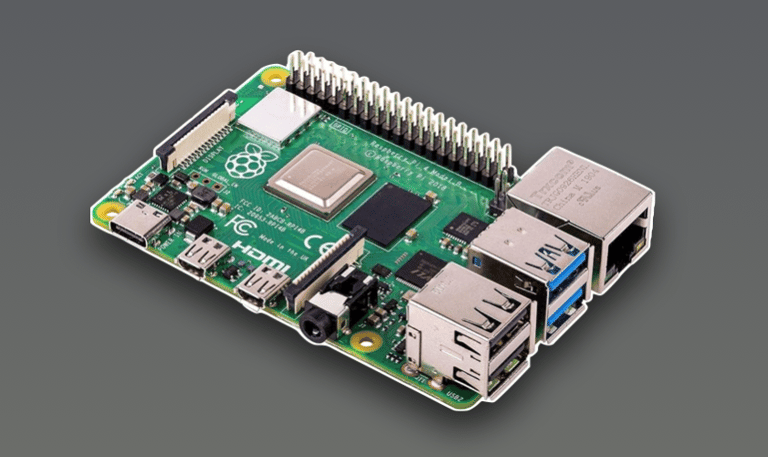
Passionate about home automation, I aim to automate my own home and those of my family and friends to make them more comfortable while optimizing energy consumption.
How ?
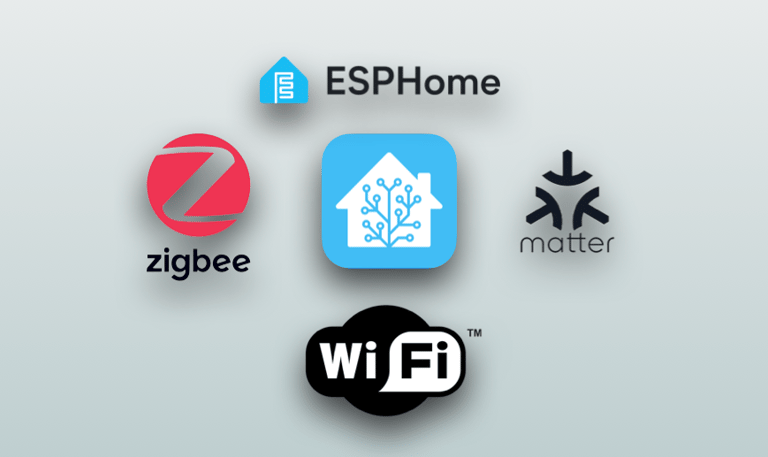
I deployed the open-source home automation management software Home Assistant, which allows me to unify all types of devices that communicate via Matter, Zigbee, WiFi, Bluetooth, or any other communication protocol.
Using the ESPHome system or the HomeSpan library, I also created customized products. More details are available in the following two sections.
Results
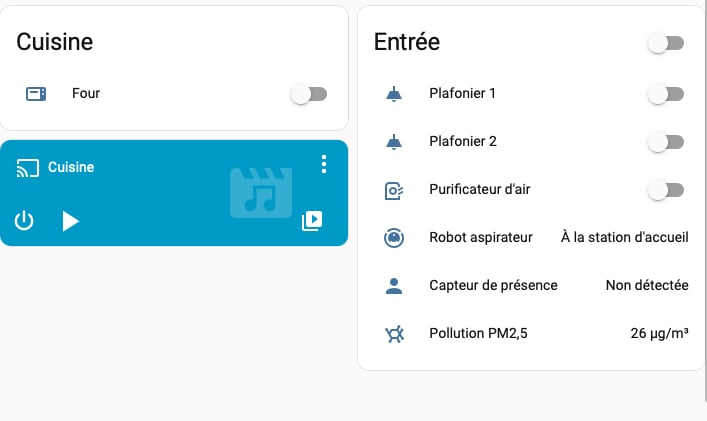
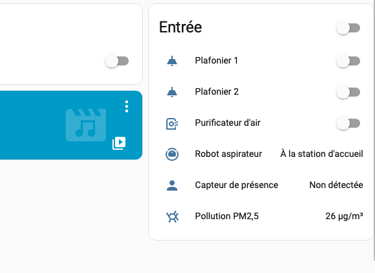
A large portion of the lighting in my home is now connected and automated to adjust brightness according to the time of day, supporting a healthy circadian rhythm. Using presence sensors, the lights turn on automatically, and specific scenes have been created to match my usage, such as a “Movie Night” mode.
Additionally, I installed an air purifier paired with a pollution sensor at the entrance. It activates automatically when odors from common areas are detected, ensuring high indoor air quality.
Planned upgrades include integrating sensors to monitor plant health and implementing intelligent heating management to optimize thermal comfort while reducing energy consumption.
Presence sensor
What ?
Automating the lighting in a home is useful for adjusting brightness and color or turning everything off automatically when no one is present.
Typically, this is done by installing smart lights controlled via a smartphone or voice assistant. However, this solution is not always the most convenient. I therefore sought to implement the most efficient method.
How ?
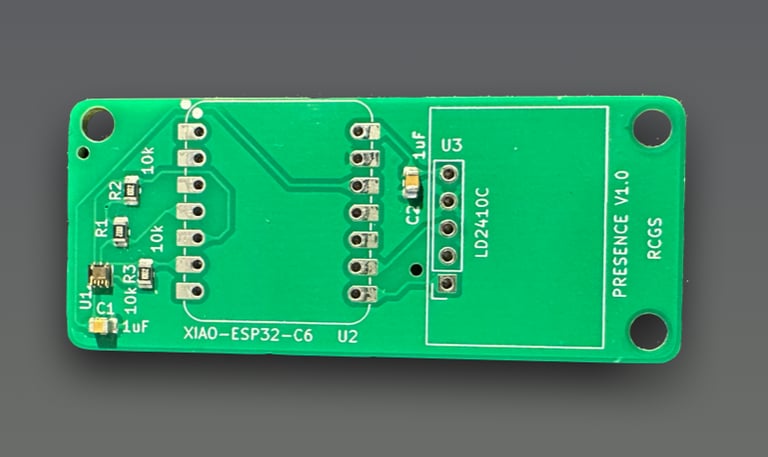
To address this challenge, I developed a home automation presence sensor based on a millimeter-wave radar, optimized for Apple HomeKit and compatible with Home Assistant.
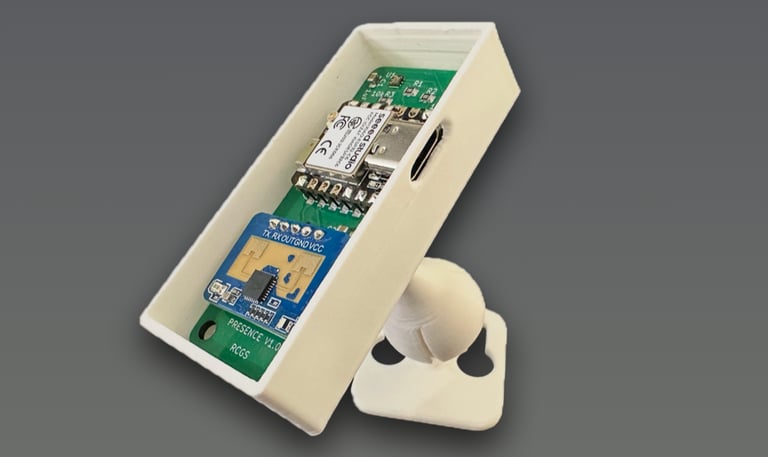
The system uses an ESP32-C6 that communicates with the LD2410C radar via a serial connection and with the LTR303 light sensor via TWI. All components are mounted on a PCB designed in KiCad, while the enclosure is modeled in FreeCAD and 3D-printed for a clean and modular assembly.
Apple HomeKit compatibility is provided through the HomeSpan library, enabling simple and secure integration into the Apple ecosystem.
Results
The enclosure can be wall-mounted and freely oriented using a ball joint, providing great flexibility for detection.
During the first power-up, the device creates a Wi-Fi access point to enter the home network information. Pairing with HomeKit is then done via an NFC tag or a QR code.
Once configured, presence and light data are displayed directly in the Home app. This allows a room to be illuminated automatically when someone is present and the light level is sufficiently low.
The radar can also be configured through a web interface.
Planned upgrades include replacing the LD2410C with a radar featuring more antennas, such as the LD2461, to add spatial information to the presence sensor.
Connected chicken coop
What ?
The connected chicken coop addresses several simple challenges. First, hens need a secured shelter at night to be protected from predators. Additionally, a chicken coop is sometimes located far from the house, which complicates door operation, wireless communication, and power supply.
How ?
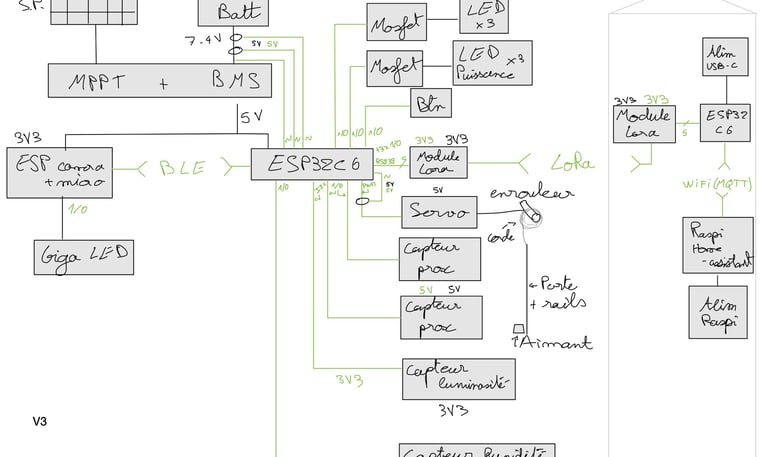
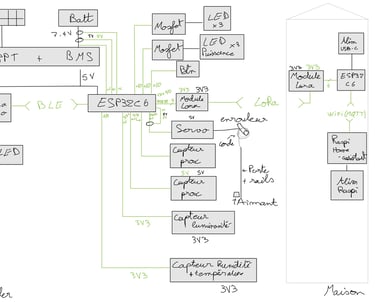
The chicken coop is energy-autonomous thanks to a battery and solar panels. It measures outdoor temperature, humidity, and light, and operates a sliding door. The door position is tracked using two magnetic sensors. It communicates with the home via LoRa, and the data is sent to a Home Assistant server via MQTT. This communication is bidirectional.


Results
The chicken coop door can be automated based on the status of its various sensors to detect the optimal moment to operate it. Additionally, it is possible to monitor the sensors’ status and control the door from the comfort of the home.
This project also explores different methods for detecting egg-laying, including image recognition using blob detection, an embedded vision model, or a vocal recognition model for hens.
Automatic racing boat balancing
What ?
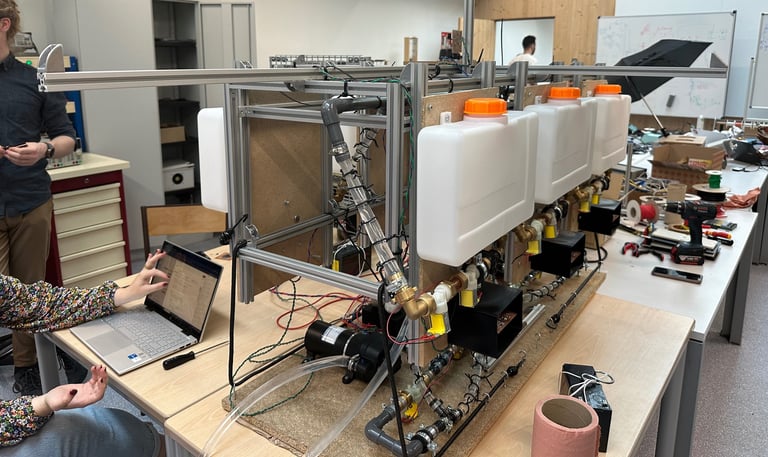
In a project, we were tasked with automating the boat’s balancing system to avoid dangerous manual adjustments in the bilge.
How ?
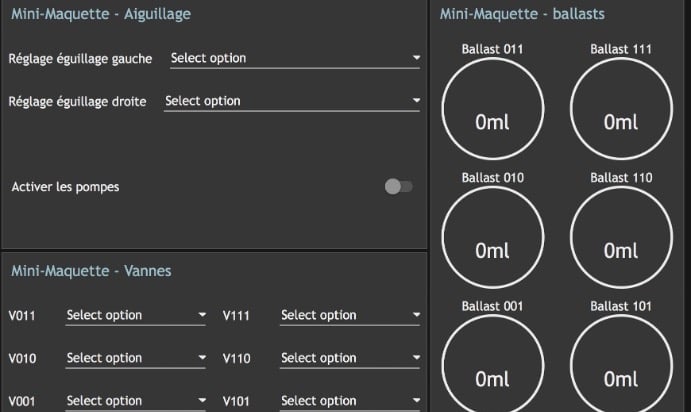
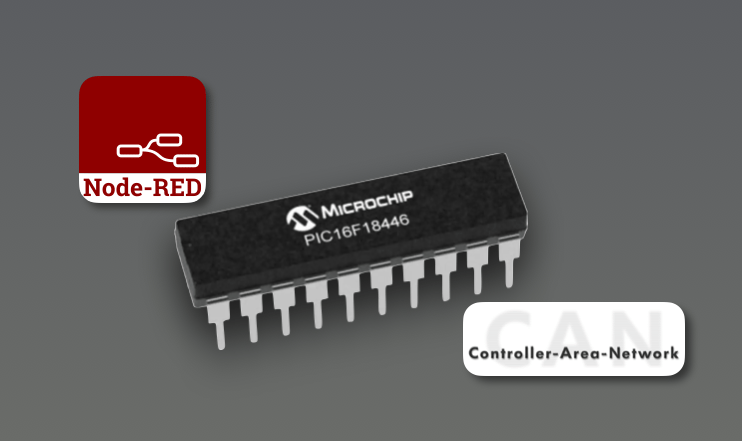
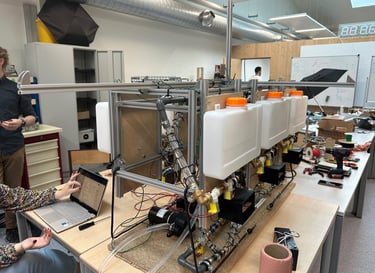
Six ballast tanks are positioned on either side of the boat and can be filled or emptied by controlling water pumps and a network of solenoid valves. Water levels in the tanks are monitored using flow meters to prevent measurement errors caused by the boat’s movements. An inertial measurement unit continuously tracks the boat’s orientation. The entire system is managed by a Node-RED server that communicates with the various components via a custom protocol based on CAN. The server also hosts a user interface that allows the skipper to monitor the system in real time while maintaining full control.
Results
The system was tested on a scale model and is able to maintain the boat’s heel by automatically adjusting the water levels in the various tanks. Additionally, the skipper can set a fixed heel via the user interface and initiate a tack with the push of a button. Since the server is hosted on the boat’s local network, the interface can be accessed from any device connected to the network.
Hardware and Software Debugging
What ?
During an internship, I was tasked with resolving hardware and software issues for a zero-emission alternative to conventional generators. This product consists of batteries, inverters, and a BMS. The bugs to be fixed were in a new user interface, which, for example, displays the battery’s state of charge on a screen and indicates the device’s operational status via an LED strip.


How ?
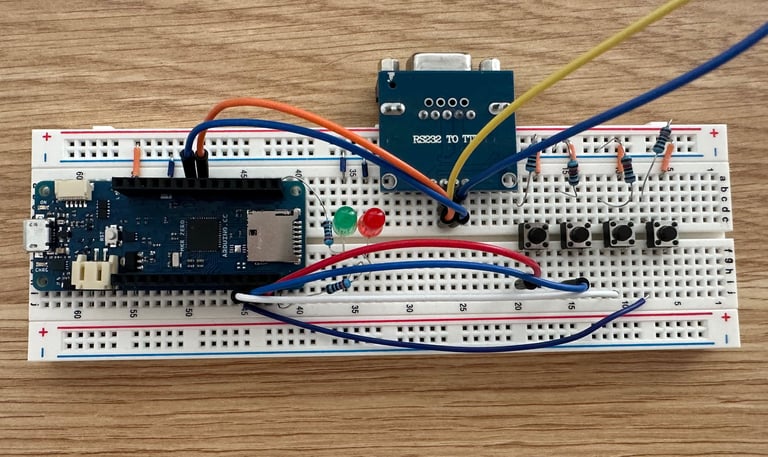
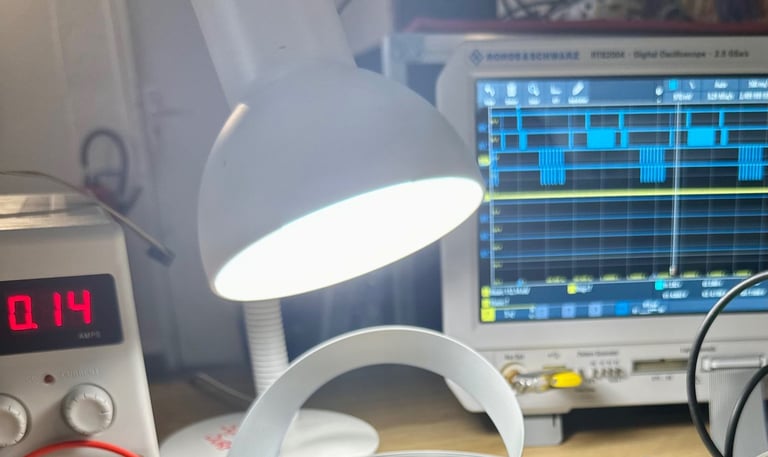
After analyzing the UI code, I identified faults using oscilloscopes, signal analyzers, and microcontroller logs.
Results
I was able to resolve real-time issues in the software as well as various hardware bugs related to the RS232 and RS485 interfaces.
Additionally, I developed a hardware and software system for automatic inverter configuration to streamline and accelerate work on the production line.

© 2026 Romain Cognasse. All rights reserved.
Contact me
I am available should you wish to learn more about my background. Please feel free to contact me by email or via the form provided. Kindly provide your phone number or email address so that I can get back to you as soon as possible.
Let's connect on LinkedIn :